Key takeaways
- Preserve the campaign promise into discovery.
- Separate buyer facts, research, and unknowns.
- Return specific outcomes to the originating team.
A prospect arrives at the first sales meeting expecting a short conversation about one problem. The seller opens with a broad pitch because the calendar invitation contains only a company name and an email address. Both people are present, but the context has been lost.
A meeting brief can close that gap. It is a small working resource that carries the buyer's stated interest, the promise that started the conversation, and the questions still unresolved. It should help a seller prepare without pretending the SDR has already completed discovery.
Use the proposed template below for meetings originating from marketing, SEO inquiries, email, or LinkedIn. Adapt it to your sales process. It is not a universal qualification standard, and completing the document does not automatically create an opportunity.
Start with the purpose, not the pitch
Write what the buyer agreed to discuss in one plain sentence. “Review whether outsourced qualification could help our small sales team” is more useful than “PipelineArc introduction.” Keep the wording faithful to the actual exchange.
Check whether the buyer agreed to a review, a demonstration, a scoping discussion, or something else. If the outreach promised a free audit, the seller needs to know exactly what that promise included. Correct a mismatch before the meeting instead of hoping the seller will negotiate around it.
Salesforce recommends sharing an agenda before a discovery meeting and checking it together at the start. The brief supports that preparation; it does not replace a buyer-facing agenda. Salesforce discovery-call guidance.
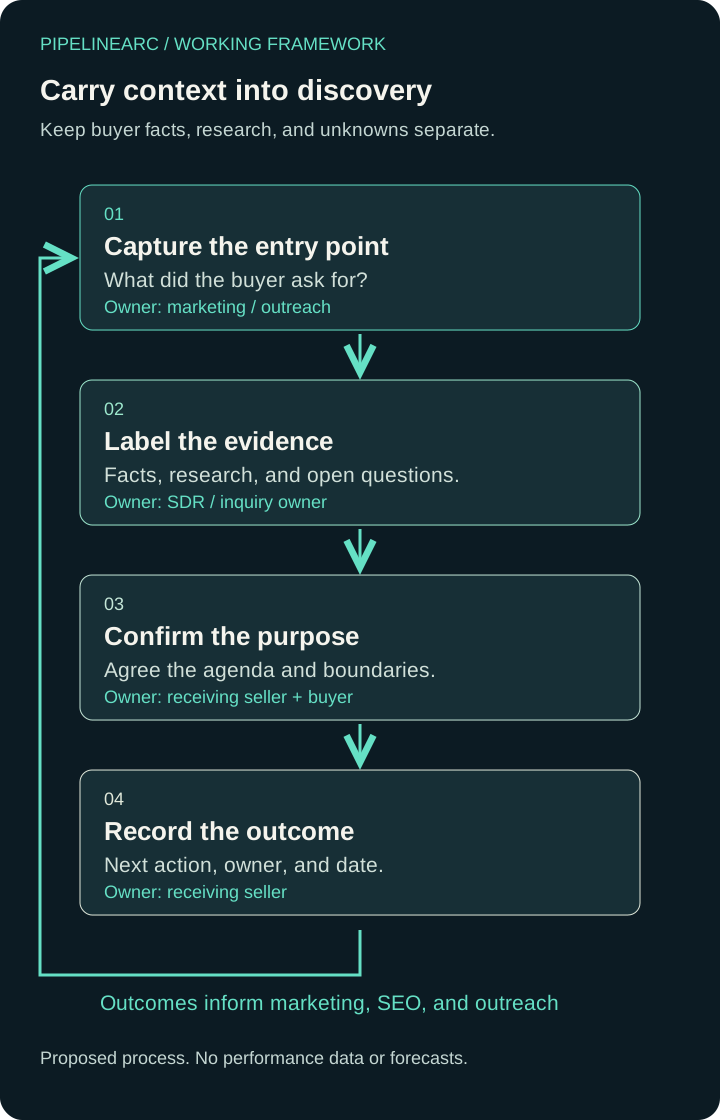
- Capture the entry point
What did the buyer ask for?
Owner: Marketing / outreach - Label the evidence
Facts, research, and open questions.
Owner: SDR / inquiry owner - Confirm the purpose
Agree the agenda and boundaries.
Owner: Receiving seller + buyer - Record the outcome
Next action, owner, and date.
Owner: Receiving seller
Feedback → Marketing, SEO, and outreach: outcomes and buyer questions refine the next invitation.
This is a proposed workflow, not a measured customer journey. Follow the connected stages from top to bottom, then use the labeled feedback path to improve the next interaction.
Keep three kinds of information separate
Buyer-stated facts come from the person's own messages or conversations. Record what they said, where it was captured, and the date. “We want to compare options next month” is a statement about their interest; it is not a confirmed buying deadline.
Research observations come from sources such as the company's website or a public role listing. Give the seller a link and a date. A hiring announcement may help frame a question, but it does not establish that the company wants an outsourced supplier. Label it as research rather than a qualification result.
Open questions are the gaps to investigate. Budget, decision ownership, timing, current tools, and service fit may all remain unknown. Write “not discussed” where appropriate. A blank field invites the receiving seller to assume the answer was forgotten; an explicit unknown tells them what still needs a conversation.
For example, if a marketing director replies “Please send details,” record that request. Do not translate it into “budget approved” or “ready for proposal.” The distinction protects both the buyer's expectations and your reporting.
The meeting brief template
Keep the resource in the account or opportunity record your team actually uses. Link to the original conversation where authorized instead of copying every message into multiple tools.
1. Record and people
- Account or buying initiative:
- Buyer name and stated role:
- Other confirmed attendees:
- Receiving seller and SDR owner:
- Meeting date, time zone, and access details:
Confirm the time zone explicitly when the team and buyer work in different countries. Do not infer purchasing authority from a title or assume that an invited person has accepted.
2. Entry point and promise
- Source: inquiry, email reply, LinkedIn conversation, or referral:
- Relevant campaign, service page, or content:
- What the buyer asked for:
- What your team offered or promised:
- Source link and last update:
Only record an entry page or channel when it is actually known. A prospect who mentions an article may have found it through several routes. An unavailable attribution field is a measurement limitation, not a reason to invent a source.
3. Evidence and unknowns
- Buyer-stated problem or desired change:
- Current approach, if discussed:
- Relevant research, with source and date:
- Agreed fit criteria checked:
- Unknowns or contradictory information:
Keep this section short enough to read before the call. Include information that helps the conversation, not unrelated personal details. Where access is restricted, share the authorized record with the authorized seller rather than creating an unrestricted copy.
4. Agreed purpose and proposed questions
- Buyer-agreed meeting purpose:
- Suggested agenda to confirm with the buyer:
- Questions needed to understand fit:
- Boundaries: topics or commitments not yet agreed:
Possible questions include: What is difficult about the current process? What would a useful improvement look like? Who else would need to evaluate a change? These are prompts for listening, not a script to interrogate every buyer in the same order.
5. Ownership after the meeting
- Person responsible for recording the outcome:
- Next action, owner, and date, if agreed:
- Status: continue, return for clarification, defer, or close:
- Reason and feedback for the originating team:
These statuses are proposed working labels. Define them locally and keep meeting occurrence separate from opportunity acceptance. A held meeting can still reveal poor fit or no current need.
Give the receiving seller a useful review step
Ask the seller to read the brief before the conversation. They can accept it for preparation, request a specific missing detail, or flag a mismatch in the agreed purpose. A return should name the gap: “Need to clarify whether the buyer expects implementation in this review” is actionable; “bad lead” is not.
Some questions should remain for discovery. Do not turn the handoff into a requirement that an early-stage buyer disclose every commercial detail before a conversation. The check is whether the seller understands the context well enough to begin responsibly.
At the start of the meeting, summarize the purpose and invite correction. Research and prior messages may be out of date. Salesforce also describes discovery as continuing through a complex sale, which is a useful reminder to keep checking your understanding. Salesforce discovery-call guidance.
Close the return path
After the meeting, record the buyer's actual questions and the agreed outcome. If several buyers arrive expecting something the service does not include, review the campaign or page that set that expectation. If the agenda consistently omits a question buyers care about, update it.
Send feedback to the team that can act on it: marketing for positioning, SEO for useful explanations, outreach for the invitation, SDRs for early context, and the seller for the next conversation. Keep observations distinct from explanations until actual records support a pattern.
Use a Pipeline Review to map how buyer context moves through your handoffs. PipelineArc can help connect marketing, SEO, outreach, qualification, and AE support around clear responsibilities and a practical meeting process.
← Back to all insights